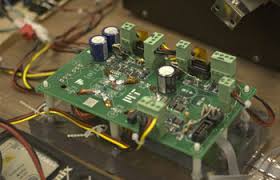
Brief description of the content of the course (Course Catalog Description): Operating characteristics of power semiconductor devices such as Bipolar Junction Transistors, IGBTs, MOSFETs and Thrusters. Fundamentals of power converter circuits including dc/dc converters phase controlled ac/dc rectifiers and dc/ac inverters. Practical issues in the design and operation of converters. Course available on videotape.
Pre-requisites or Co-requisites : ECE 342 or equiv or cons inst
Develop and quantify common performance objectives for power electronic circuits, such as efficiency, power factor, etc.
Develop simple dc-dc power electronic converter topologies to meet certain functional specifications
Analyze dc-dc power electronic converter operation to develop design guidelines for choice of switching devices and reactive elements
Identify and use switching device and reactive component performance characteristics to apply them appropriately in dc-dc power electronic circuits
Complete preliminary design of inductors and transformers
Describe steady state and dynamic behavior of dc-dc power electronic converters using equivalent circuits, matrix models and small signal transfer functions
Design simple closed loop regulators for dc-dc power electronic converters to meet functional objectives
Identify and synthesize general circuit topologies to realize inverters and rectifiers for single phase and three phase applications
Describe operation of diode and SCR based power electronic circuits
Use systematic problem solving techniques to partition complex problems
Use simplifying assumptions to approach solutions to ill-posed design problems
Present solutions to technical problems effectively
Use mathematical analysis software tools to solve engineering design problems
ABET Student Learning Outcomes:
Ability to apply mathematics, science and engineering principles.
Ability to design a system, component, or process to meet desired needs.
Ability to identify, formulate and solve engineering problems.
Ability to communicate effectively.
Recognition of the need for and an ability to engage in life-long learning.
Knowledge of contemporary issues.
Ability to use the techniques, skills and modern engineering tools necessary for engineering
Practice Brief List of Topics to be covered:
Linear regulators, Power converter topologies/architecture, Rectifiers, Square wave inverters, Power semiconductor applications, Magnetics design, Frequency response of power converters, Regulator design and realization, Sine wave inverters, and SCR converters